"Teaching Virtues adds to the understanding
of the connections
between the teaching of virtues and the
practice of moral
reciprocity within community.......the wisdom
to the authors'
specific recommendations for reforming the
curriculum-which
is much needed at this time."--C.A.
Bowers, Professor Education,
Portland State University
TEACHING VIRTUES.. BOOKS.. FOUR ARROWS
AND OTHER BOOK BY FOUR ARROWS
DON TRENT JACOBS
"This book offers a new but ancient perspective
on teaching virtues.
Like the American Indian people who practiced
it for thousands of
years, it does not allow us to separate
character from content, and
by this, makes it possible for us all
to 'walk the talk.' "
--Sunita Gandhi,
President-Worker, The Council for Global
Education and Dignity
"brilliantly written, utterly practical"
--Thom Hartmann, ADD A Different Perception
Teaching Truly
by Four Arrows ....Don Trent Jacobs
For the first time in educational publishing, Teaching Truly provides classroom teachers course specific guidelines for augmenting mainstream curriculum standards so as to facilitate more truthful and more meaningful coursework. Respectfully and appropriately incorporating proven approaches of traditional Indigenous Peoples to authentic student engagement and learning in mainstream classroom, this book helps teachers overcome the barriers that have long stifled their ability to “Teach Truly.” The material first exposes corporatism and hegemony hidden in specific subjects; then reveals real-world statistics that show the ineffectiveness of contemporary curricula in achieving positive outcomes; offers starkly contrasting and time tested natural learning perspectives for each subject that stem from Indigenous wisdom; and then suggests specific exercises and dialogue topics for classroom learning. Each chapter is easily adaptable to different grade levels. Eight specific courses are addressed, including English Language Arts, Mathematics, Music, Geography and Health Education, but the interconnected information can assist teachers with teaching all mainstream topics.
Praise for Teaching Truly
"A remarkable, nerve-touching book..." John Pilger
"Penetrating, fearless and practical..."Thom Hartmann
"Enlightening ...we must pay careful attention...or we are doomed." Noam Chomsky
"This handbook for teachers is a vibrant and essential text..." William Ayers
"Educators should be paying attention to what Four Arrows offers.." Bill McKibben
Last Song of
the Whales
by Four Arrows (D. T. Jacobs)
978-0-9845552-5-3
Anticipated September 2010 Release Savant publishing
Reviews!!!!!!
A humpback whale mysteriously takes a mixed-blood American Indian professor to sea. While struggling to survive, the man begins to reclaim his indigenous roots, and in the process discovers thousands of whales on a suicide mission in the North Pacific. When he theorizes the dire effects the whale's action could have for all of life on earth, he and a sympathetic woman marine biologist, influenced by a Hawaiian shaman's dream, against all odds, try to warn the world in time.
"I have read Four Arrows’ novel, Last Song of the Whales, and thank him for this most engaging presentation which can allow people to become aware of the critical marine conservation issues facing our world. Entertainment is a good way to educate people and this is what he is doing.--Francine Cousteau, President of the Cousteau Society"The Ocean's Plastic Plague is doubling every decade with no end in sight. As a result, her creatures are suffering and dying in droves. Four Arrows offers the profound insight that only by realizing our true partnership with the most charismatic of sea creatures will a distracted humanity find the courage it needs to stop in its tracks to retool and redirect its destructive productivity."-Captain Charles Moore, Algalita Marine Research Foundation
#1. Last Song of the Whales is a both a tone
poem and and an ecological treatise that takes the reader into a world
of sensation and thought unlike any other. Some might call it imposssible...
as improbable a story as the one about Men walking on the Moon would be
to a Kogi tribesman from the remote mountains of Columbia.
It is easy to suspend what we think to be true when Four Arrows speaks
to us so convincingly about both the universal intelligence of our planet
and the
terrible state of our life support system. He has offered us another way and
another reason to "Live Like We Love The Ocean."--Tim Dykman, Co-Director
Ocean Revolution
MORE BOOKS BELOW........................
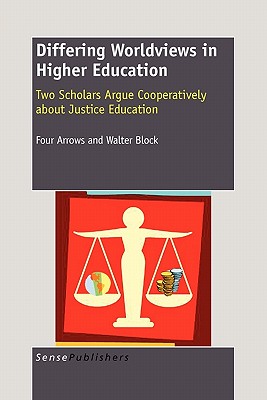
Differing Worldviews in Higher Education: just
published DEC 2010
just
published DEC 2010
Two Scholars Argue Cooperatively about Justice Education
By Four Arrows and Walter Block
Two noted professors on opposite sides of the cultural wars come together and engage in "cooperative argumentation." One, a "Jewish, atheist libertarian" and the other a "mixed blood American Indian" bring to the table two radically different worldviews to bear on the role of colleges and universities in studying social and ecological justice. The result is an entertaining and enlightening journey that reveals surprising connections and previously misunderstood rationales that may be at the root of a world too polarized to function sanely
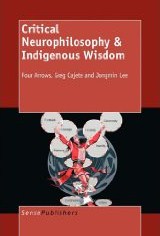
Critical Neurophilosophy &
Indigenous Wisdom
This book begins a long overdue dialogue between Western neuropsychology and Indigenous wisdom.
The latter holds that technology, including that which supports the neurosciences, is an important aspect of humanity, but that without a deeper understanding of the sacred, natural world, its consequences will continue to disrupt the balance of life on Earth. ON Amazon:
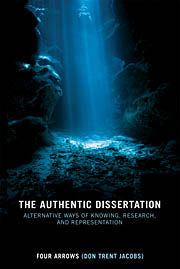
The
Authentic Dissertation
Alternative Ways of Knowing, Research and Representation
By Four Arrows AKA Don Trent Jacobs
The Authentic Dissertation is a road map for students who want to make their dissertation more than a series of hoop-jumping machinations that cause them to lose the vitality and meaningfulness of their research.
Students and tutors are presented with practical guidance for the kind of alternative dissertations that many educators believe are needed to move Doctoral and Master’s level work beyond the limitations that currently stifle authentic contributions for a better world
.Drawing on his Cherokee/Creek ancestry and the Raramuri shamans of Mexico the author explores how research can regain its humanist core and find its true place in the natural order once more. Four Arrows provides a degree of credibility that will help graduate students legitimize their ideas in the eyes of more conservative university committees. This inspiring book will also help academics who sincerely want to see these alternative forms but are concerned about the rigor of alternativedissertation research and presentation.Publisher site
A timely text that has appeared at a stage in world history when‘business as usual’ would appear to be a very dangerous pathway’ Dr Christine Black, Journal of Higher Education Policy and Management, May 2009
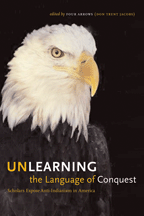
Unlearning the Language of Conquest
Scholars Expose Anti-Indianism in America
Edited by Four Arrows (Don Trent Jacobs)
" Outstanding scholarship. . . .
Giant first steps towards the goal of providing a truthful and constructive understanding of indigenous worldviews."
—Daniel R. Wildcat, Professor of Sociology and American Indian Studies, Haskell Indian Nations University
Responding to anti-Indianism in America,
the wide-ranging perspectives culled in Unlearning the Language of Conquest
present a provocative account of the contemporary hegemony still at work
today, whether conscious or unconscious. Four Arrows has gathered a rich
collection of voices and topics, including: Waziyatawin Angela Cavender
Wilson's "Burning Down the House: Laura Ingalls Wilder and American
Colonialism," which probes the mentality of hatred woven within the
pages of this iconographic children's literature.
David N. Gibb's "The Question of Whitewashing in American History and
Social Science," featuring a candid discussion of the spurious relationship
between sources of academic funding and the types of research allowed or discouraged.
Barbara Alice Mann's "Where Are Your Women? Missing in Action," displaying
the exclusion of Native American women in curricula that purport to illuminate
the history of Indigenous Peoples.
Bringing to light crucial information and perspectives on an aspect of humanity
that pervades not only U.S. history but also current sustainability, sociology,
and the ability to craft accurate understandings of the population as a whole,
Unlearning the Language of Conquest yields a liberating new lexis for realistic
dialogues.
Four Arrows (Wahinkpe Topa), also known as Don Trent Jacobs, is a Professor at Fielding Graduate University's College of Educational Leadership and ChangeRead the Introduction of this dynamic publication with contributions from the leading First Nations authors.
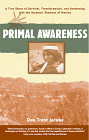
Primal Awareness : A True Story of Survival
Transformation, and Awakening with the Raramuri Shamans of Mexico
Editorial Reviews Talking Leaves,1998
Reading this book is like looking closely at the weave
of an intricately designed blanket. . . . This fascinating, inspiring
book harbors a wealth of information on the interconnectedness of all
beings--an awareness that is accessible to all of us as integral parts
of the whole. A compelling spiritual and true adventure quest. Highly
acclaimed by Dan Millman, Sam Keen and others. In 1983, caught in a violent
rainstorm
while kayaking the Rio Urique in Mexico's Copper Canyon, Don Trent Jacobs
was swept into an impassable catacomb of underwater tunnels toward what
he believed was certain death. But instead of panic, Jacobs found himself
filled with a strange consciousness that left him feeling at peace and
invigorated with a confidence he had never before known. Moments later
he was spit from the tunnel alive--not at the end of his journey, but only
at its beginning.
Primal Awareness tells the story of Don Trent Jacobs's remarkable vision
of the human mind and heart and the compelling spiritual quest that brought
him
to it. Through his experiences with the Raramuri people of Mexico and his research
of other indigenous societies, Jacobs identifies what he calls our "primal
awareness," an innate knowledge that exists within us all. Jacobs shows how
we can rediscover this primordial mandate that unites all things and that helps
us to find our own inner strength an harmony.Read
endorsements by other authors Read
a reviewRead
and article by Don Jacobs about Primal Awareness
Published by Inner Traditions and can be ordered there or from amazon.com . Accompanying images of the journey and narration in video is available at: 1-310-594-3022
The
Shrimp Habit: WHY
IT IS DEVASTATING OUR WORLD
AND WHAT YOU CAN DO ABOUT IT
BY
FOUR ARROWS
(Don Trent Jacobs, Ph.D., Ed.D.)
with
BRIAN ELLISON..........Trafford Publishing:
Victoria, BC, Canada V8T 4P4
250-383-6864 Toll Free in Canada and U.S.A.: 1-888-232-4444http://trafford.com/05-1975
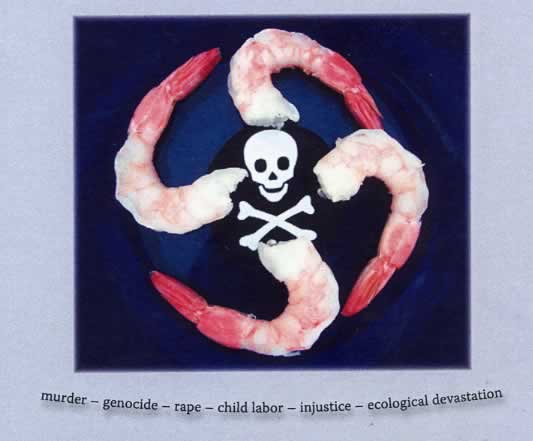
his booklet is intended to motivate most readers to stop eating shrimp, unless it comes from one of the few alternative sources that are not a travesty. It might also be sufficient to get readers to send copies to grocery stores, restaurants, friends and relatives. Eating shrimp (same as prawns) has major environmental and human rights consequences. Shrimp farms are polluting marine environments, drinking water and agricultural lands with tons of chemicals, antibiotics and organic waste. Nearly 40 percent of the world’s “ocean nurseries”- the mangrove swamps- have been eradicated by bull dozers making room for shrimp farms.1 (Interestingly, this loss of mangroves contributed significantly to the deadly toll from the recent Tsunami.2) Indigenous communities have been forced off their lands around the world, and many have been murdered by hired guns for resisting. If all this is not bad enough, the shrimp that people consume from these farms might be detrimental to your health.
Shrimp trawling (as in “shrimp boats are a comin’”) is as destructive as the farming industry. Trawling nets destroy ocean floor habitat, decimate natural food supplies, and wastefully kill a myriad of sea creatures. An average of 95 percent of what trawlers scoop up is not shrimp, but rather turtles, sea horses, juvenile red snappers, and many other important and endangered fish whose dead bodies are generally thrown back into the ocean.
Of all the environmental problems facing our world today, this is one of the easiest to solve.
American Assassination:
The Strange Death of Senator Paul Wellstone
By Four Arrows ( Don Trent Jacobs) and Jim Fetzer / Release date Oct.2004
Although no one can prove exactly what happened in the events leading to Wellstone’s death, these two Ph.D.s point out the official story’s inconsistencies and deliberate omissions. With a methodical argument, they present evidence of an official cover-up, a compelling motive for Wellstone’s assassination, and a more probable explanation for how Senator Wellstone was downed. Click to read a press release........Read a review by David Griffin author of The New Pearl Harbor
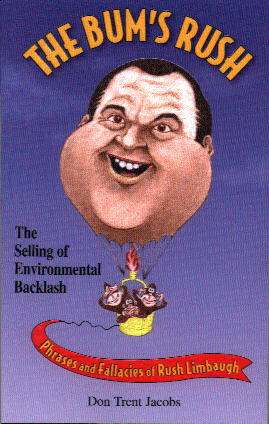
The Selling of Environmental Backlash : Phrases and Fallacies of Rush Limbaugh
In an entertaining and educational way this book teaches critical thinking and unmasks methods of persuasion. It is used in critical thinking, persuasive language,and writing classes by many universities.( Published by Legendary Publishing .
1-360-594-3022 or order online at amazon.com
Earlier Works
Happy Exercise: An Adventure into the World of Fitness for Children
First children's book to teach kids not to
believe fallacies of TV commercials and to encourage a healthy lifestyle
for the whole family.(Anderson World ,1971)
Coloring book 1-928-523-0421 or wahinkpe@yahoo.com
Patient Communication for First Responders and EMS Personnel
The first book to show the effect of healing
suggestions during the first hour of trauma. These suggestions can be used
to enable the patient to use their own healing potential to stabilized
such autonomic nervous system functions as bleeding and blood pressure.
This approach is endorsed by such notables as Norman Cousins. (Published
Prentice Hall,1988)
1-800-282-0693. Training
video based on the
book is available from Westwood 1-818-242-1159
Ride & Tie: The Challenge of Running and Riding
The book that introduced this equestrian sport to the world. Training tips for horse and rider on this challenging sport. (Runner's World ) Available through Ride and Tie Association
Getting Your Executive Fit
The first book on employee fitness programs. MacMillan, 1978)
Physical Fitness and Public Safety
The first book on fitness
standards for firefighters, which resulted in nation standards.
1,2,& 3 editions published by
National Fire Protection Agency (1976)
GUEST CHAPTERS BELOW
Defending Pubic Schools......................edited by E. Wayne Ross
Chapter title: Character Education : Coming Full Cirlce by Don Trent Jacobs
Caring for Life ...........edited by Riane Eisley and Ron Miller
GUEST CHAPTERSEducation as Enforcement: The Militarization and Corporation of Schools
by Kenneth J. Saltman (Editor), David A. Gabbard (Editor)
*Contributors: Henry A. Giroux, Kenneth J. Saltman, Noam Chomsky, Robin Truth Goodman, David A. Gabbard, Pauline Lipman, Pepi Leistyna, Enora A. Brown, Don Trent Jacobs, Marvin J. Berlowitz, Nathan A. Long, Haggith Gor, Julie Webber, Sheila Landers Macrine, Ron Scapp, Sandra Jackson, Kevin D. Vinson, E. Wayne Ross, Eugene Provenzo, Jr., William M. Reynolds, Michael W. Apple, Peter McLaren, Ramin Farahmandpur*
Book Description With surveillance cameras, chainlink fences, surprise searches and metal detectors our public schools increasingly resemble the military and prisons. The first book to focus on the intersections of militarization, corporations and education, Education as Enforcement shows how schooling has become the means through which the expansion of global corporate power is enforced. Whether through accountability and standards, school security, or other discipline based reforms, militarized education in the U.S. needs to be understood in relation to the enforcement of corporate economic imperatives and to a sense of "law and order" that pervades our popular culture. Such an understanding will enable the conception of strategies for renewing a spirit of public civic engagement and democratic responsibility.
About the Author Kenneth J. Saltman is Assistant Professor of Social and Cultural Studies at DePaul University. David A. Gabbard is Associate Professor in the Department of Curriculum and Instruction at East Carolina University's School of Education.
Echoes
from the Poisoned Well:
Global Memories of Environmental Injustice
Edited by:
Sylvia Hood Washington, Heather Goodall, and
Paul Rosier
Foreword by Martin Melosi, University of Houston
Epilogue by Jeffrey Stine, Smithsonian Institution
The emerging environmental justice movement has created greater awareness among scholars that communities from all over the world suffer from similar environmental inequalities. This volume takes up the challenge of linking the focussed campaigns and insights from African American campaigns for environmental justice with the perspectives of this global group of environmentally marginalized groups. The editorial team has drawn on Washington's work, on Paul Rosier's study of Native American environmentalism, and on Heather Goodall's work with Indigenous Australians to seek out wider perspectives on the relationships between memories of injustice and demands for environmental justice in the global arena. This collection contributes to environmental historiography by providing "bottom up" environmental histories in a field which so far has mostly emphasized a "top down" perspective, in which the voices of those most heavily burdened by environmental degradation are often ignored. The essays here serve as a modest step in filling this lacuna in environmental history by providing the viewpoints of peoples and of indigenous communities which traditionally have been neglected while linking them to a global context of environmental activism and education.
List of Contributors
Four Arrows (aka Don Trent Jacobs),
K. Animashaun Ducre Anya Bernstein, Marja K. Bulmer, Lois Gibbs, Heather
Goodall, Renée K. Gosson, Peggy James, Jacqui Katona, Rauna Kuokkanen,
Bill E.Lawson, Martin Melosi, Cynthia J. Miller, Pataka Moore, Paul C.
Rosier, Jane Bloodworth Rowe, Jane Sayers, Rachael Selby, Phia Steyn,
Jeffrey K. Stine, Julie Sze, Stephen Wallace Taylor, Elise Tempelhoff,
Johann Tempelhoff, Guy Thompson, Nancy Unger, John Walsh, Sylvia Hood
Washington
The
Hidden History of 9-11-2001
Edited by: Paul Zarembka
ISBN: 0-7623-1305-6
State University of New York at Buffalo, NY, USA
Read Four Arrows Chapter Below Description:
Description
This important volume brings together rigorous scholarship on the events
of 9-11-2001, and assesses whether the truth has been told by the U.S.
government. The lead chapter shows that eleven of FBI-named Arabic hijackers
could not have been on the planes, while the Dulles airport videotape
-- essentially being the case that hijackers boarded flights -- has very
serious authentication problems. The next three chapters examine insider
trading beforehand and the 9-11 flights themselves, then the evidence
-- based partly upon newly-released reports of more than 500 firefighters
-- permitting a conclusion that three buildings in the WTC complex were
brought down by demolition, followed by discussion of scheduled military
drills which confused standard operating procedures, and concluding with
a surprising connection to the death of Senator Wellstone, leading critique
of the Bush administration. The third part opens with a chapter examining
the connection between Al-Qaeda and Western covert operations, showing
how Al-Qaeda is inseparably connected to the latter. The following chapter
shows that Machiavellian state terrorism is rather common and not at
all unlikely for 9-11, while the following examines how the 9-11 Commission
wrote its own history, rather than reporting and analyzing true history.
The rise of Islamophobia as an ideological force to sustain U.S. imperialism
is then introduced. The final chapter, while not explicit, offers a possible
connection to the process of undermining pensions in the U.K. The volume
can be seen as a definitive, scholarly explanation of 9-11 as a world-changing
event.
Audience
Economists: Acad
Educating For Humanity: Rethinking the Purposes
of Education
by Mike Seymour (Editor)
The promise and necessity of working toward “a world that works for all” is a viable aspiration for education at a time when the worldwide crises in social justice, peace, democracy and ecological integrity have become the defining issues of our times. Ample evidence from many schools past and present prove that the purpose of educating young people for character, compassion, purpose and commitment is integral with the mastery of intellectual skills and life competencies.
The school experience of young people must work interdependently and in harmony with the development of a whole, human being. Educational policy directions, especially over the last twenty years, have veered far away from the important work of educating for humanity. This book makes a powerful appeal to revisit educational purpose in light of what is most fundamental and important to human beings everywhere.
nd previously misunderstoo rationales that may be at the root of a wrld
too polarized to function sanely.

.jpg)